Entree: France – Burgundy – Jambon Persillé (Cold herbed ham set in a clear parsley-infused aspic)
Food safety reminder: Follow safe food-handling practices and use a food thermometer to verify safe internal cooking temperatures.
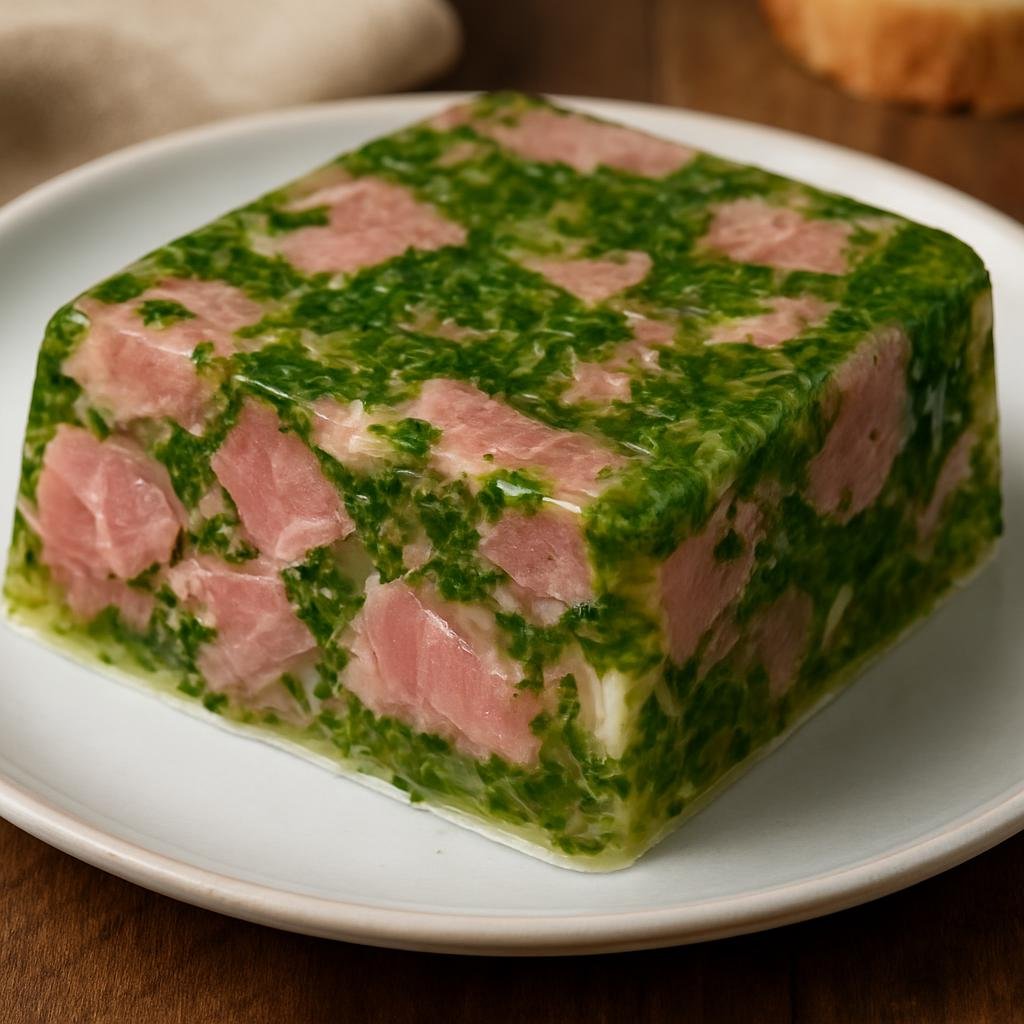
Serving Size: 6
Approximate Time
Prep
35 min
Cook
2 hrs 30 min
Additional
6 hrs
Total
8 hrs 30 min
Ingredients
U.S. measurements first, metric equivalents in parentheses. Conversions are approximate; oz means weight ounces, not fluid ounces.
1 ham hock, 1 lb 15 3/4 oz (900 g) gross; estimated 10 5/8 oz (300 g) cooked edible meat
Cooked cured ham, 1 lb (454 g), diced (estimated edible portion: 1 lb (454 g))
Cold water, 4 cups (960 ml)
Dry white wine, 1 cup (240 ml)
Onion, 1 medium (about 3 7/8 oz (110 g)), halved
Carrot, 1 medium (about 2 1/8 oz (61 g)), roughly chopped
Celery, 1 medium stalk (about 1 7/16 oz (40 g)), roughly chopped
Bay leaves, 2 (about 0.014 oz (0.4 g))
Whole black peppercorns, 1 tbsp (about 8 g)
Garlic, 4 cloves (about 0.42 oz (12 g)), crushed
Flat-leaf parsley leaves, 2 1/8 oz (60 g), finely chopped
White wine vinegar, 1 tbsp (15 ml) (about 0.53 oz (15 g))
Unflavored powdered gelatin, 0.21 oz (6 g) (estimated edible portion: 0.21 oz (6 g))
Cold water for blooming gelatin, 3 tbsp (45 ml)
Salt, 0.18 oz (5 g), plus an unspecified amount to taste
Freshly ground black pepper, 0.035 oz (1 g)
Optional serving accompaniments: Dijon mustard, cornichons, and crusty baguette; quantities unspecified
Show original ingredient measurements
1 ham hock, 900 g gross; estimated 300 g cooked edible meat
Cooked cured ham, 454 g, diced (estimated edible portion: 454 g)
Cold water, 960 ml
Dry white wine, 240 ml
Onion, 1 medium (about 110 g), halved
Carrot, 1 medium (about 61 g), roughly chopped
Celery, 1 medium stalk (about 40 g), roughly chopped
Bay leaves, 2 (about 0.4 g)
Whole black peppercorns, 1 tbsp (about 8 g)
Garlic, 4 cloves (about 12 g), crushed
Flat-leaf parsley leaves, 60 g, finely chopped
White wine vinegar, 15 ml (about 15 g)
Unflavored powdered gelatin, 6 g (estimated edible portion: 6 g)
Cold water for blooming gelatin, 45 ml
Salt, 5 g, plus an unspecified amount to taste
Freshly ground black pepper, 1 g
Optional serving accompaniments: Dijon mustard, cornichons, and crusty baguette; quantities unspecified
Instructions
U.S. measurements first, metric equivalents in parentheses. Conversions are approximate.
1. Rinse the ham hock. Put it in a large pot with 4 cups (960 ml) cold water, the white wine, onion, carrot, celery, bay leaves, peppercorns, and garlic.
2. Bring to a gentle simmer, skimming any foam. Reduce the heat, partially cover, and simmer gently for 2 to 2½ hours, until the hock meat is tender and the stock is flavorful.
3. Remove the hock. Strain the cooking liquid through a fine-mesh sieve into a bowl and discard the strained solids. If the stock does not become strongly gelatinous when chilled, sprinkle the powdered gelatin over 3 tbsp (45 ml) cold water and let it hydrate. Stir it into 1/2 cup (120 ml) warmed strained stock until dissolved, then mix it into the remaining strained stock.
4. Season the stock with 0.18 oz (5 g) salt, the ground black pepper, and white wine vinegar. Taste and adjust with additional salt if desired. Cool until lukewarm.
5. Remove the meat from the hock, discarding the bones and excess fat. Shred or chop the meat and combine it with the diced cooked ham.
6. Stir the chopped parsley into the cooled stock. Fold in the ham mixture.
7. Transfer the mixture to a terrine mold or loaf pan, distributing the meat evenly. Press gently to remove air pockets and ensure the stock covers the ham.
8. Cover and refrigerate until fully set, at least 6 hours or overnight. To unmold, briefly dip the bottom of the mold in warm water and invert onto a platter.
9. Slice and serve cold, with the optional Dijon mustard, cornichons, and crusty baguette.
Show original instructions
1. Rinse the ham hock. Put it in a large pot with 960 ml cold water, the white wine, onion, carrot, celery, bay leaves, peppercorns, and garlic.
2. Bring to a gentle simmer, skimming any foam. Reduce the heat, partially cover, and simmer gently for 2 to 2½ hours, until the hock meat is tender and the stock is flavorful.
3. Remove the hock. Strain the cooking liquid through a fine-mesh sieve into a bowl and discard the strained solids. If the stock does not become strongly gelatinous when chilled, sprinkle the powdered gelatin over 45 ml cold water and let it hydrate. Stir it into 120 ml warmed strained stock until dissolved, then mix it into the remaining strained stock.
4. Season the stock with 5 g salt, the ground black pepper, and white wine vinegar. Taste and adjust with additional salt if desired. Cool until lukewarm.
5. Remove the meat from the hock, discarding the bones and excess fat. Shred or chop the meat and combine it with the diced cooked ham.
6. Stir the chopped parsley into the cooled stock. Fold in the ham mixture.
7. Transfer the mixture to a terrine mold or loaf pan, distributing the meat evenly. Press gently to remove air pockets and ensure the stock covers the ham.
8. Cover and refrigerate until fully set, at least 6 hours or overnight. To unmold, briefly dip the bottom of the mold in warm water and invert onto a platter.
9. Slice and serve cold, with the optional Dijon mustard, cornichons, and crusty baguette.
Estimated Nutritional Information*
Per serving | Servings: 6
Calories: 365 kcal
Carbohydrates: 6.3 g
Protein: 24.2 g
Fat: 23.5 g
Generated: 2026-11-06T06:55:51+00:00
*Values are estimates based on USDA data and mathematical calculations. Actual values may vary. Where data are unavailable, those contributions are excluded. Calories, Carbohydrates, Protein and Fat are known subtotals. Missing contributions are unknown, not zero.