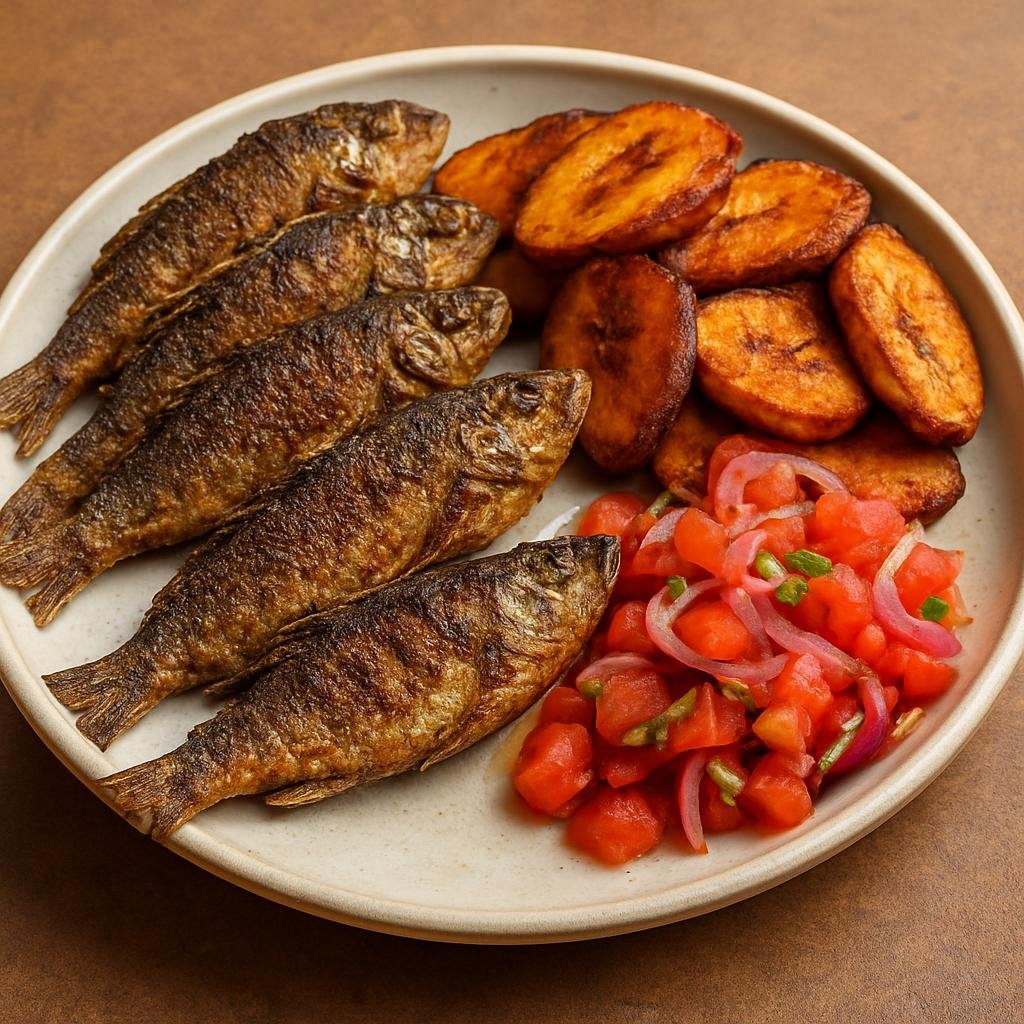
Entree: Burundi – Central Culinary Region – Sambaza (Small freshwater fish, seasoned and pan-fried until crisp, served with fried plantains and a tomato-onion relish)
Food safety reminder: Follow safe food-handling practices and use a food thermometer to verify safe internal cooking temperatures.
Serving Size: 4
Approximate Time
Prep
20 min
Cook
15 min
Total
35 min
Ingredients
U.S. measurements first, metric equivalents in parentheses. Conversions are approximate; oz means weight ounces, not fluid ounces.
1 lb (454 g) cleaned, scaled small freshwater fish (sambaza; estimate 8 oz (227 g) edible raw fish after bones and other refuse)
4 1/4 oz (120 g) all-purpose flour, for dredging
0.21 oz (6 g) salt, plus an unspecified additional amount to taste
0.035 oz (1 g) black pepper, freshly ground
1 cup (240 ml) vegetable oil for frying (about 7 3/4 oz (221 g)), plus 2 tbsp (30 ml) for plantains (about 1 oz (28 g))
2 large plantains, ripe but firm, peeled and sliced 0.512 in (1.3 cm) thick (estimated 14 1/8 oz (400 g) peeled edible plantain)
5 1/4 oz (150 g) onion, thinly sliced
6 3/8 oz (180 g) tomatoes, diced
0.106 oz (3 g) garlic, minced
1 small fresh chili, optional and finely chopped (estimated 0.18 oz (5 g))
1 tbsp (15 ml) lemon juice
0.28 oz (8 g) fresh cilantro, chopped
Show original ingredient measurements
454 g cleaned, scaled small freshwater fish (sambaza; estimate 227 g edible raw fish after bones and other refuse)
120 g all-purpose flour, for dredging
6 g salt, plus an unspecified additional amount to taste
1 g black pepper, freshly ground
240 ml vegetable oil for frying (about 221 g), plus 30 ml for plantains (about 28 g)
2 large plantains, ripe but firm, peeled and sliced 1.3 cm thick (estimated 400 g peeled edible plantain)
150 g onion, thinly sliced
180 g tomatoes, diced
3 g garlic, minced
1 small fresh chili, optional and finely chopped (estimated 5 g)
15 ml lemon juice
8 g fresh cilantro, chopped
Instructions
U.S. measurements first, metric equivalents in parentheses. Conversions are approximate.
1. Pat the cleaned fish dry. Season inside and out with the 0.21 oz (6 g) salt and black pepper.
2. Put the flour in a shallow dish. Dredge each fish lightly, coating it evenly, and shake off excess flour.
3. Heat 1 cup (240 ml) vegetable oil in a wide heavy skillet over medium-high heat until shimmering. Fry the fish in batches without crowding, 3–4 minutes per side or until golden, crisp, and cooked through. Transfer to a paper-towel-lined plate and keep warm.
4. In a separate skillet, heat 2 tbsp (30 ml) vegetable oil over medium heat. Fry the plantain slices in batches until golden on both sides and tender, about 2–3 minutes per side. Drain on paper towels and season lightly with additional salt if desired.
5. Wipe out the plantain pan. Add a little oil if needed and sauté the onion until soft, about 5 minutes. Add the garlic and optional chili; cook for 1 minute. Stir in the tomatoes and cook until they soften into a saucy relish, about 5–7 minutes. Stir in the lemon juice and cilantro, then season with additional salt to taste.
6. Serve the hot fish with the fried plantains alongside and the tomato-onion relish over the fish.
Show original instructions
1. Pat the cleaned fish dry. Season inside and out with the 6 g salt and black pepper.
2. Put the flour in a shallow dish. Dredge each fish lightly, coating it evenly, and shake off excess flour.
3. Heat 240 ml vegetable oil in a wide heavy skillet over medium-high heat until shimmering. Fry the fish in batches without crowding, 3–4 minutes per side or until golden, crisp, and cooked through. Transfer to a paper-towel-lined plate and keep warm.
4. In a separate skillet, heat 30 ml vegetable oil over medium heat. Fry the plantain slices in batches until golden on both sides and tender, about 2–3 minutes per side. Drain on paper towels and season lightly with additional salt if desired.
5. Wipe out the plantain pan. Add a little oil if needed and sauté the onion until soft, about 5 minutes. Add the garlic and optional chili; cook for 1 minute. Stir in the tomatoes and cook until they soften into a saucy relish, about 5–7 minutes. Stir in the lemon juice and cilantro, then season with additional salt to taste.
6. Serve the hot fish with the fried plantains alongside and the tomato-onion relish over the fish.
Estimated Nutritional Information*
Per serving | Servings: 4
Calories: 807 kcal
Carbohydrates: 60.9 g
Protein: 15.3 g
Fat: 58.1 g
Saturated fat: 9.2 g
Cholesterol: 36 mg
Fiber: 3.9 g
Sodium: 634 mg
Potassium: 862 mg
Calcium: 60 mg
Iron: 2.79 mg
Vitamin A: 111 µg RAE
Vitamin C: 32.2 mg
Generated: 2026-11-06T06:53:53+00:00
*Values are estimates based on USDA data and mathematical calculations. Actual values may vary. Where data are unavailable, those contributions are excluded. Sodium is a known subtotal. Missing contributions are unknown, not zero.