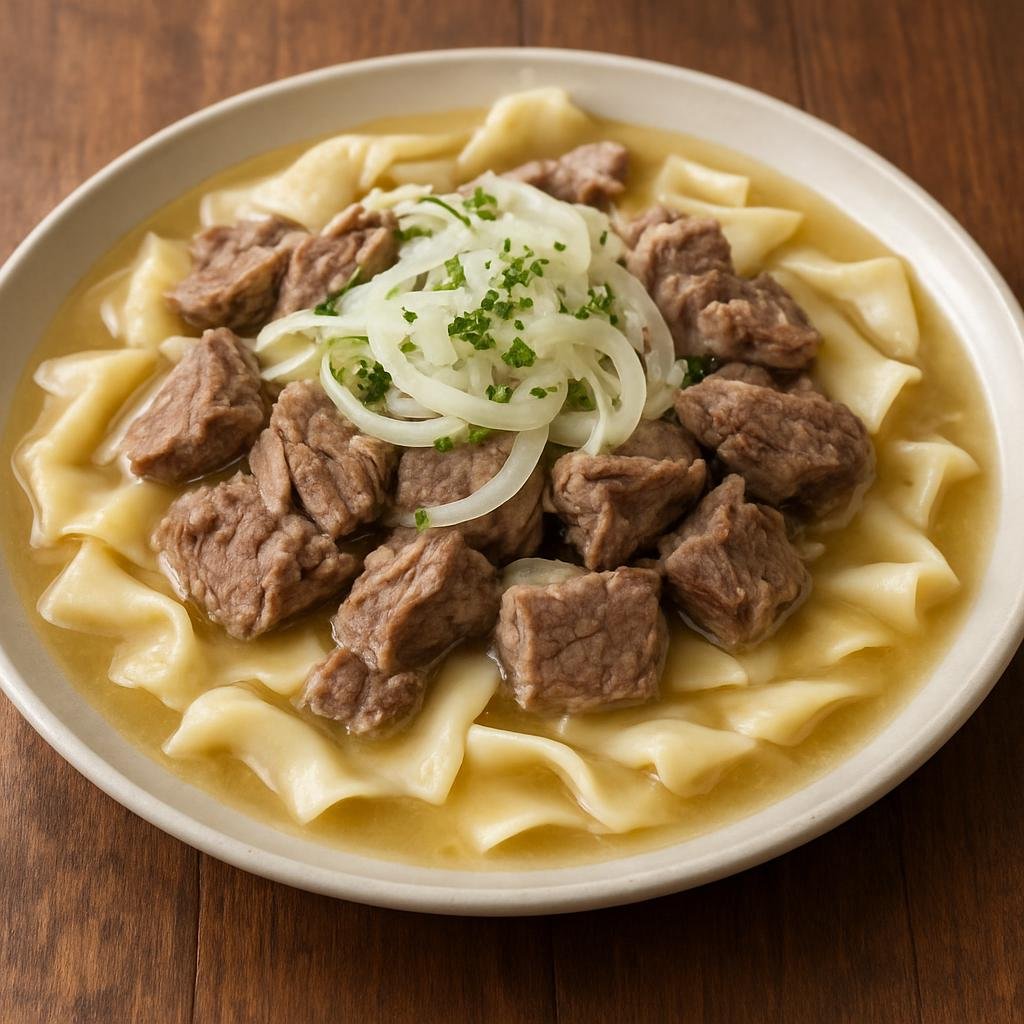
Entree: Uzbekistan – Fergana Valley – Beshbarmak (Boiled meat served over wide hand-cut noodles with onion broth)
Food safety reminder: Follow safe food-handling practices and use a food thermometer to verify safe internal cooking temperatures.
Ingredients
U.S. measurements first, metric equivalents in parentheses. Conversions are approximate; oz means weight ounces, not fluid ounces.
- 2 lb (900 g) lamb shoulder, bone-in
- 1 lb (450 g) beef brisket or shank, bone-in
- 12 cups (2.8 L) water
- 2 tsp (10 g) kosher salt, plus more to taste
- 1 tsp (5 g) whole black peppercorns
- 2 bay leaves (2 leaves)
- 3 medium onions, about 1 lb (450 g), thinly sliced
- 1 tbsp (15 ml) white vinegar
- 4 cups (480 g) all-purpose flour
- 2 large eggs, about 3 1/2 oz (100 g) total
- 1 tsp (5 g) fine salt for dough
- 1/2 cup (120 ml) warm water for dough (adjust as needed)
- 2 tbsp (30 ml) vegetable oil for dough
- 2 tbsp (30 g) unsalted butter, melted (optional for tossing noodles)
- 1/2 cup (15 g) chopped fresh parsley or dill for garnish
- 1 tsp (2 g) freshly ground black pepper for serving
Show original ingredient measurements
- 2 lb (900 g) lamb shoulder, bone-in
- 1 lb (450 g) beef brisket or shank, bone-in
- 12 cups (2.8 L) water
- 2 tsp (10 g) kosher salt, plus more to taste
- 1 tsp (5 g) whole black peppercorns
- 2 bay leaves (2 leaves)
- 3 medium onions, about 1 lb (450 g), thinly sliced
- 1 tbsp (15 ml) white vinegar
- 4 cups (480 g) all-purpose flour
- 2 large eggs, about 100 g total
- 1 tsp (5 g) fine salt for dough
- 1/2 cup (120 ml) warm water for dough (adjust as needed)
- 2 tbsp (30 ml) vegetable oil for dough
- 2 tbsp (30 g) unsalted butter, melted (optional for tossing noodles)
- 1/2 cup (15 g) chopped fresh parsley or dill for garnish
- 1 tsp (2 g) freshly ground black pepper for serving
Instructions
U.S. measurements first, metric equivalents in parentheses. Conversions are approximate.
1. Place the lamb and beef in a large stockpot and cover with 12 cups (2.8 L) cold water. Bring to a gentle boil over medium-high heat, skimming any foam. Add 2 tsp (10 g) salt, peppercorns, and bay leaves. Reduce heat to low and simmer, covered, until meats are very tender, about 2 to 2 1/2 hours.
2. Meanwhile, make the dough: in a large bowl combine 4 cups (480 g) flour and 1 tsp (5 g) salt. Whisk eggs, 1/2 cup (120 ml) warm water, and 2 tbsp (30 ml) vegetable oil, then add to the flour. Mix until a firm dough forms, knead on a lightly floured surface until smooth and elastic, about 8–10 minutes. Cover and rest 30 minutes.
3. When the meats are tender remove them from the broth to a cutting board. Strain the broth into another pot and keep hot; adjust seasoning with salt if needed. Reserve 2 cups (480 ml) of hot broth for the onion sauce.
4. Thinly slice the cooked meats across the grain into bite-sized pieces; keep warm in a covered dish. If bones remain, remove and discard.
5. Prepare the onion sauce: place the thinly sliced onions in a bowl and pour 2 cups (480 ml) of hot strained broth over them; add 1 tbsp (15 ml) white vinegar and let sit 10–15 minutes to soften and mellow. Taste and add a pinch of salt if needed.
6. Roll the rested dough thinly (about 1/16 inch (2 mm)) and cut into wide squares or ribbons roughly 2–3 inches (5–7 cm) across. Dust lightly to prevent sticking.
7. Bring a large pot of salted water to a boil. Cook the noodles in batches until tender, 2–4 minutes depending on thickness. Drain and, if desired, toss with 2 tbsp (30 g) melted butter to prevent sticking.
8. To serve: place a layer of noodles on a large platter, arrange sliced meats over noodles, spoon the onion-broth mixture and a few ladlefuls of hot clear broth over everything. Garnish with chopped parsley or dill and freshly ground black pepper. Serve family-style so diners can ladle more broth over their portions.
Show original instructions
1. Place the lamb and beef in a large stockpot and cover with 12 cups (2.8 L) cold water. Bring to a gentle boil over medium-high heat, skimming any foam. Add 2 tsp (10 g) salt, peppercorns, and bay leaves. Reduce heat to low and simmer, covered, until meats are very tender, about 2 to 2 1/2 hours.
2. Meanwhile, make the dough: in a large bowl combine 4 cups (480 g) flour and 1 tsp (5 g) salt. Whisk eggs, 1/2 cup (120 ml) warm water, and 2 tbsp (30 ml) vegetable oil, then add to the flour. Mix until a firm dough forms, knead on a lightly floured surface until smooth and elastic, about 8–10 minutes. Cover and rest 30 minutes.
3. When the meats are tender remove them from the broth to a cutting board. Strain the broth into another pot and keep hot; adjust seasoning with salt if needed. Reserve 2 cups (480 ml) of hot broth for the onion sauce.
4. Thinly slice the cooked meats across the grain into bite-sized pieces; keep warm in a covered dish. If bones remain, remove and discard.
5. Prepare the onion sauce: place the thinly sliced onions in a bowl and pour 2 cups (480 ml) of hot strained broth over them; add 1 tbsp (15 ml) white vinegar and let sit 10–15 minutes to soften and mellow. Taste and add a pinch of salt if needed.
6. Roll the rested dough thinly (about 1/16 inch / 2 mm) and cut into wide squares or ribbons roughly 2–3 inches (5–7 cm) across. Dust lightly to prevent sticking.
7. Bring a large pot of salted water to a boil. Cook the noodles in batches until tender, 2–4 minutes depending on thickness. Drain and, if desired, toss with 2 tbsp (30 g) melted butter to prevent sticking.
8. To serve: place a layer of noodles on a large platter, arrange sliced meats over noodles, spoon the onion-broth mixture and a few ladlefuls of hot clear broth over everything. Garnish with chopped parsley or dill and freshly ground black pepper. Serve family-style so diners can ladle more broth over their portions.
Per serving | Servings: 4
Generated: 2026-11-05T19:45:25+00:00
*Values are estimates based on USDA data and mathematical calculations. Actual values may vary. Where data are unavailable, those contributions are excluded. Calories, Carbohydrates, Protein, Fat, Saturated fat, Cholesterol, Fiber, Sodium, Potassium, Calcium, Iron, Vitamin A, Vitamin C and Vitamin D are known subtotals. Missing contributions are unknown, not zero.