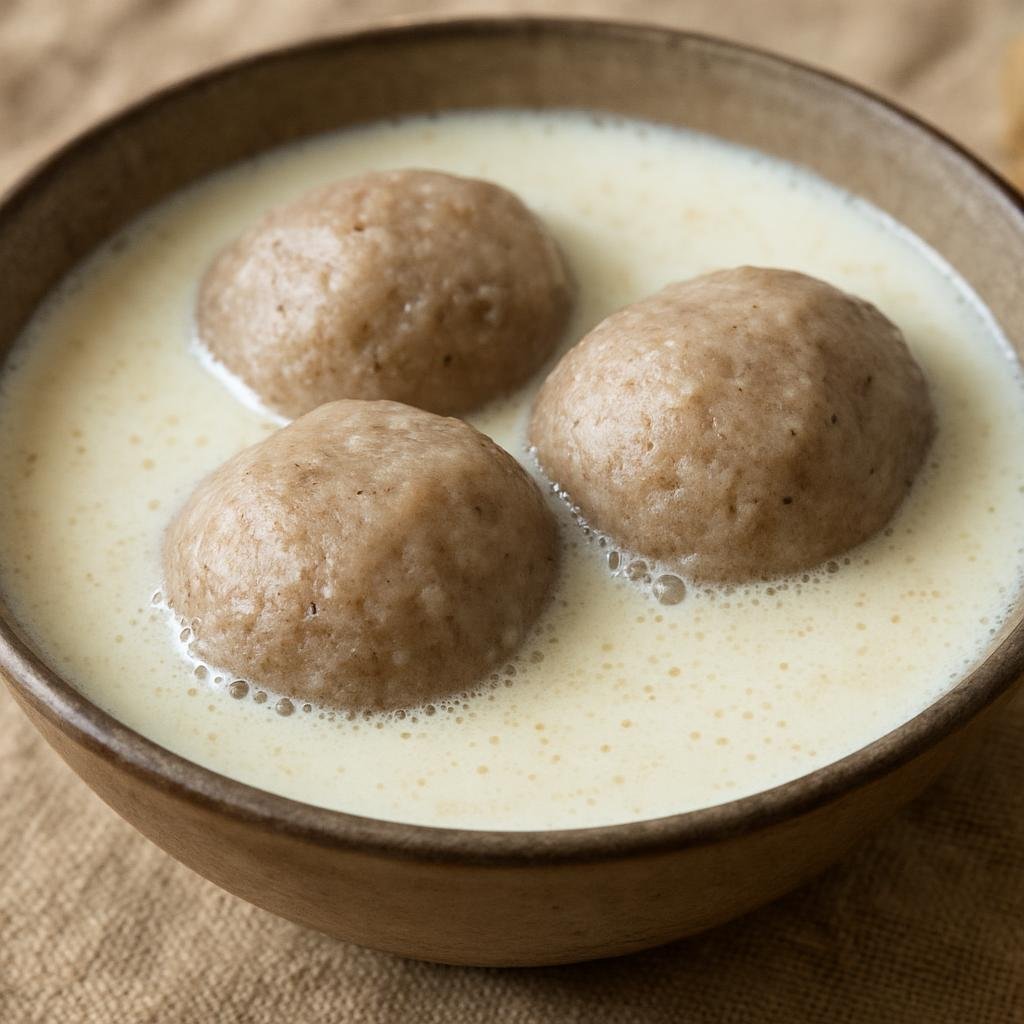
Entree: Nigeria – Fulani Pastoral – Fura da Nono (Millet dumplings served in fermented milk, a traditional Fulani staple beverage-meal)
Food safety reminder: Follow safe food-handling practices and use a food thermometer to verify safe internal cooking temperatures.
Serving Size: 4
Approximate Time
Prep
20 min
Cook
10 min
Additional
8 hrs
Total
8 hrs 30 min
Ingredients
- 2 cups (240 g) millet flour (or sorghum/guinea corn flour)
- 1 1/4 cups (300 ml) boiling water, plus extra as needed
- 2 tbsp (30 ml) vegetable oil
- 2 tbsp (25 g) granulated sugar, plus extra to taste
- 1 tsp (5 g) salt
- 1 tsp (2 g) ground ginger
- 1/4 tsp (0.5 g) ground cloves
- 1/4 tsp (0.5 g) ground black pepper or to taste
- 4 cups (950 ml) whole cow's milk (for nono) OR 2 cups (475 ml) plain yogurt + 2 cups (475 ml) water as quick substitute
- 3 tbsp (45 g) plain yogurt as starter if fermenting fresh milk
- 1–2 tbsp (15–30 ml) honey or additional sugar to sweeten nono (optional)
- Ice cubes as needed (optional, when serving chilled)
Instructions
U.S. measurements first, metric equivalents in parentheses. Conversions are approximate.
1. In a large bowl combine the millet flour, salt, ground ginger, ground cloves, and ground black pepper; set aside.
2. Pour the boiling water over the flour mixture and stir quickly with a wooden spoon until it forms a thick, shaggy dough; add the oil and continue mixing until smooth and pliable. If too dry, add hot water 1 tbsp (15 ml) at a time.
3. Transfer the dough to a clean surface and knead for 5–7 minutes until cohesive and slightly elastic. Divide into 8 equal portions and roll each into a ball about 1.5–2 inches (3–5 cm) diameter.
4. Place the fura balls into a pot of lightly simmering water and cook 8–10 minutes until they firm up; remove with a slotted spoon and place on a plate to cool slightly. Alternatively, steam for 8–10 minutes.
5. Once cool, gently mash or pound each ball in a mortar or with the back of a spoon to loosen the interior texture and then roll back into smooth balls; dust with a little millet flour to prevent sticking.
6. To make traditional nono: warm the whole milk to about 100–110°F (38–43°C), whisk in 3 tbsp (45 g) plain yogurt as starter, cover and keep in a warm place 8–12 hours until tangy and fermented. Refrigerate to chill. Quick substitute: mix 2 cups (475 ml) plain yogurt with 2 cups (475 ml) water and whisk until smooth.
7. Sweeten the nono to taste with 1–2 tbsp (15–30 ml) honey or sugar if desired and chill.
8. To serve, place 2 fura balls per serving in a bowl or glass, pour 1 cup (240 ml) chilled nono over them, mash slightly with a spoon so the fura softens into the milk, add ice if desired, and serve immediately.
Show original instructions
1. In a large bowl combine the millet flour, salt, ground ginger, ground cloves, and ground black pepper; set aside.
2. Pour the boiling water over the flour mixture and stir quickly with a wooden spoon until it forms a thick, shaggy dough; add the oil and continue mixing until smooth and pliable. If too dry, add hot water 1 tbsp at a time.
3. Transfer the dough to a clean surface and knead for 5–7 minutes until cohesive and slightly elastic. Divide into 8 equal portions and roll each into a ball about 1.5–2 inches (3–5 cm) diameter.
4. Place the fura balls into a pot of lightly simmering water and cook 8–10 minutes until they firm up; remove with a slotted spoon and place on a plate to cool slightly. Alternatively, steam for 8–10 minutes.
5. Once cool, gently mash or pound each ball in a mortar or with the back of a spoon to loosen the interior texture and then roll back into smooth balls; dust with a little millet flour to prevent sticking.
6. To make traditional nono: warm the whole milk to about 100–110°F (38–43°C), whisk in 3 tbsp (45 g) plain yogurt as starter, cover and keep in a warm place 8–12 hours until tangy and fermented. Refrigerate to chill. Quick substitute: mix 2 cups (475 ml) plain yogurt with 2 cups (475 ml) water and whisk until smooth.
7. Sweeten the nono to taste with 1–2 tbsp (15–30 ml) honey or sugar if desired and chill.
8. To serve, place 2 fura balls per serving in a bowl or glass, pour 1 cup (240 ml) chilled nono over them, mash slightly with a spoon so the fura softens into the milk, add ice if desired, and serve immediately.
Estimated Nutritional Information*
Per serving | Servings: 4
Calories: 485 kcal
Carbohydrates: 71.3 g
Protein: 14.4 g
Fat: 15.7 g
Saturated fat: 6 g
Cholesterol: 26 mg
Fiber: 1.8 g
Sugar: 25.7 g
Sodium: 600 mg
Potassium: 418 mg
Calcium: 303 mg
Iron: 3.03 mg
Vitamin A: 115 µg RAE
Vitamin C: 0.1 mg
Vitamin D: 3.2 µg
Generated: 2026-11-05T19:44:14+00:00
*Values are estimates based on USDA data and mathematical calculations. Actual values may vary. Where data are unavailable, those contributions are excluded. Calories, Carbohydrates, Protein, Fat, Saturated fat, Cholesterol, Fiber, Sugar, Sodium, Potassium, Calcium, Iron, Vitamin A, Vitamin C and Vitamin D are known subtotals. Missing contributions are unknown, not zero.