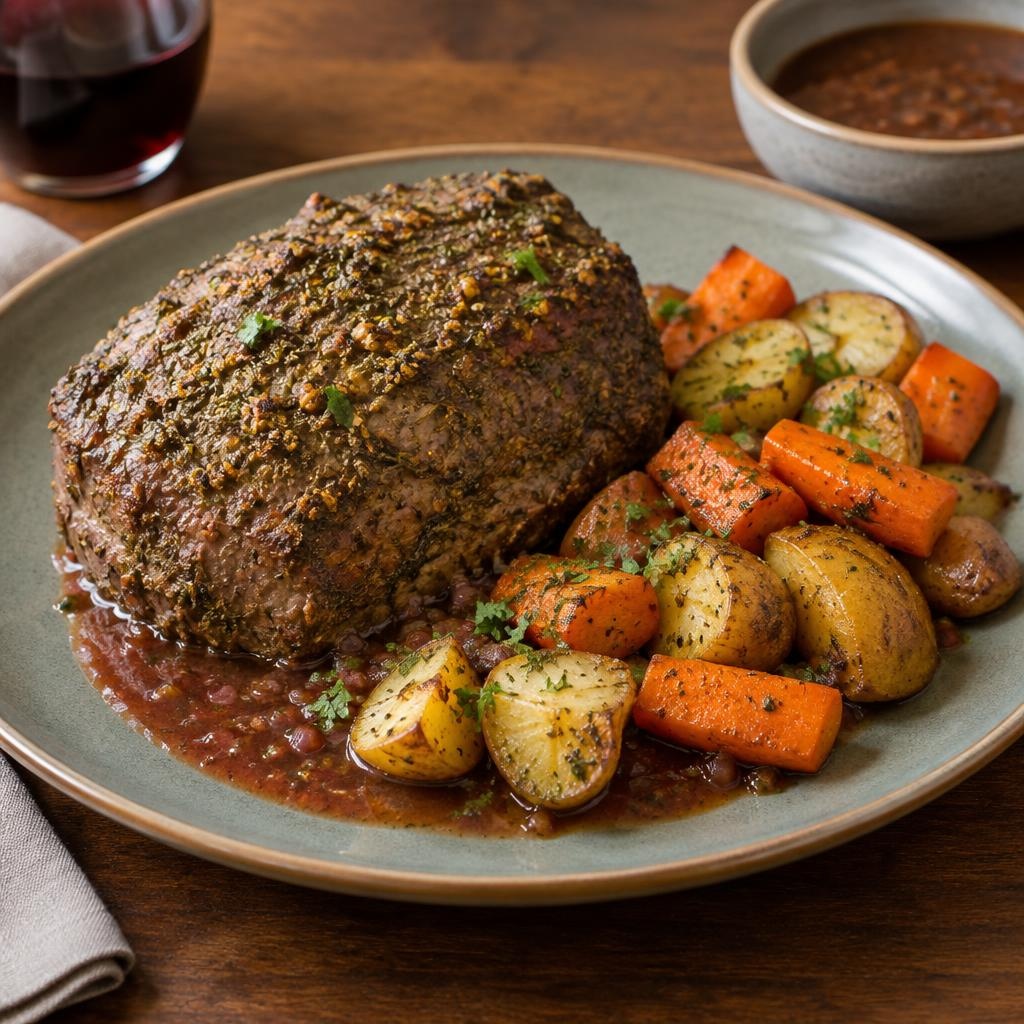
Entree: United States – Classic Rump Roast with Mustard-Herb Crust and Red Wine Pan Sauce
Food safety reminder: Follow safe food-handling practices and use a food thermometer to verify safe internal cooking temperatures.
Created by Kitchen2MyTable
Inspired by “Perfect Bottom Round Roast Recipe (Rump Roast)”
Ingredients
- 1 bottom round (rump) roast, approx. 4 lb (1.8 kg) total
- 2 tbsp (30 ml) olive oil
- 4 cloves garlic, minced
- 2 1/2 tsp (about 2.5 g) dried thyme leaves
- 2 1/2 tsp (about 2.5 g) dried rosemary, crushed
- 2 1/2 tsp (about 2.5 g) dried oregano leaves
- 2 tsp (approx. 10 g) kosher salt
- 2 tsp (approx. 4 g) coarse black pepper
- 2 tbsp (30 ml) Dijon mustard
- 2 shallots, finely chopped, approx. 2 oz (60 g) total
- 1 cup (240 ml) dry red wine
- 1 1/2 cups (360 ml) low-sodium beef stock
- 2 tbsp (30 g) unsalted butter
- 1 tbsp (8 g) all-purpose flour
- 1 lb (450 g) baby potatoes, halved
- 8 oz (225 g) carrots, peeled and cut into 2-inch (5 cm) pieces
- 1 tbsp (15 ml) additional olive oil (for vegetables)
- 2 tbsp (8 g) fresh parsley, chopped (for garnish)
- salt, to taste
- black pepper, to taste
Instructions
U.S. measurements first, metric equivalents in parentheses. Conversions are approximate.
1. Remove roast from packaging and pat dry with paper towels. In a small bowl combine minced garlic, dried thyme, crushed dried rosemary, dried oregano, 2 tsp (10 ml) kosher salt, and 2 tsp (10 ml) coarse black pepper; mix to distribute.
2. Brush the roast with 2 tbsp (30 ml) olive oil, then spread 2 tbsp (30 ml) Dijon mustard over all surfaces. Press the herb-garlic mixture onto the mustard-coated roast so it forms an even crust. If time allows, place the roast uncovered on a tray in the refrigerator for 4–6 hours to dry the exterior (optional); otherwise proceed.
3. Preheat oven to 275°F (135°C). Remove roast from fridge and let sit at room temperature 30 minutes. Meanwhile, toss potatoes and carrots with 1 tbsp (15 ml) olive oil, a light sprinkle of salt, and black pepper; set aside on a sheet pan.
4. Place a wire rack in a roasting pan and set the roast on the rack with any fat cap up. Insert an oven-safe thermometer into the thickest part of the roast (avoid touching bone if present) and put the roast in the oven. Roast low and slow until the internal temperature reaches your target: 135°F (57°C) for medium-rare or 145°F (63°C) for medium. Expect roughly 45–55 minutes per pound, but begin checking temperature 30 minutes before the earliest estimated finish time.
5. About 45–60 minutes before the roast reaches target temperature (or once you estimate roughly 1 hour remaining), put the prepared sheet pan with potatoes and carrots on a middle rack so they roast until tender and lightly caramelized (they will finish while meat rests if needed). If your oven space is limited, roast vegetables separately at 400°F (205°C) for 35–45 minutes after the roast rests (see step 8).
6. When the roast reaches the chosen internal temperature, remove it from the oven, tent loosely with aluminum foil, and transfer to a cutting board. Keep the roasting pan with drippings on the stove over medium heat for the pan sauce. Increase oven temperature to 450°F (230°C).
7. For the pan sauce: pour off excess fat leaving about 1 tbsp (15 ml) drippings in the pan. Place the roasting pan on medium heat (or use a skillet), add 2 tbsp (30 ml) butter and the finely chopped shallots; sauté 1–2 minutes until fragrant and translucent. Sprinkle 1 tbsp (15 ml) all-purpose flour over shallots and cook, stirring, 1 minute to remove raw flour taste. Deglaze the pan with 1 cup (240 ml) dry red wine, scraping browned bits; simmer until wine is reduced by about half. Add 1 1/2 cups (360 ml) beef stock and simmer until slightly reduced and sauce coats the back of a spoon, 6–8 minutes. Whisk in remaining Dijon mustard (if desired) and adjust seasoning with salt and black pepper to taste. Strain sauce through a fine-mesh sieve into a warm container if a smooth sauce is preferred.
8. Remove foil and any thermometer probe from the roast. Return the roast to the oven for 5–8 minutes at 450°F (230°C) to deepen and crisp the crust. Meanwhile, if vegetables need finishing, roast them at 400°F (205°C) until tender and browned, 35–45 minutes total.
9. Transfer the roast to a cutting board and tent with foil; rest 15–20 minutes (this allows juices to redistribute). Slice thinly against the grain. Serve slices with roasted potatoes and carrots, spoon the red wine–shallot pan sauce over the meat, and garnish with chopped parsley.
Show original instructions
1. Remove roast from packaging and pat dry with paper towels. In a small bowl combine minced garlic, dried thyme, crushed dried rosemary, dried oregano, 2 tsp kosher salt, and 2 tsp coarse black pepper; mix to distribute.
2. Brush the roast with 2 tbsp olive oil, then spread 2 tbsp Dijon mustard over all surfaces. Press the herb-garlic mixture onto the mustard-coated roast so it forms an even crust. If time allows, place the roast uncovered on a tray in the refrigerator for 4–6 hours to dry the exterior (optional); otherwise proceed.
3. Preheat oven to 275°F (135°C). Remove roast from fridge and let sit at room temperature 30 minutes. Meanwhile, toss potatoes and carrots with 1 tbsp olive oil, a light sprinkle of salt, and black pepper; set aside on a sheet pan.
4. Place a wire rack in a roasting pan and set the roast on the rack with any fat cap up. Insert an oven-safe thermometer into the thickest part of the roast (avoid touching bone if present) and put the roast in the oven. Roast low and slow until the internal temperature reaches your target: 135°F (57°C) for medium-rare or 145°F (63°C) for medium. Expect roughly 45–55 minutes per pound, but begin checking temperature 30 minutes before the earliest estimated finish time.
5. About 45–60 minutes before the roast reaches target temperature (or once you estimate roughly 1 hour remaining), put the prepared sheet pan with potatoes and carrots on a middle rack so they roast until tender and lightly caramelized (they will finish while meat rests if needed). If your oven space is limited, roast vegetables separately at 400°F (205°C) for 35–45 minutes after the roast rests (see step 8).
6. When the roast reaches the chosen internal temperature, remove it from the oven, tent loosely with aluminum foil, and transfer to a cutting board. Keep the roasting pan with drippings on the stove over medium heat for the pan sauce. Increase oven temperature to 450°F (230°C).
7. For the pan sauce: pour off excess fat leaving about 1 tbsp drippings in the pan. Place the roasting pan on medium heat (or use a skillet), add 2 tbsp butter and the finely chopped shallots; sauté 1–2 minutes until fragrant and translucent. Sprinkle 1 tbsp all-purpose flour over shallots and cook, stirring, 1 minute to remove raw flour taste. Deglaze the pan with 1 cup dry red wine, scraping browned bits; simmer until wine is reduced by about half. Add 1 1/2 cups beef stock and simmer until slightly reduced and sauce coats the back of a spoon, 6–8 minutes. Whisk in remaining Dijon mustard (if desired) and adjust seasoning with salt and black pepper to taste. Strain sauce through a fine-mesh sieve into a warm container if a smooth sauce is preferred.
8. Remove foil and any thermometer probe from the roast. Return the roast to the oven for 5–8 minutes at 450°F (230°C) to deepen and crisp the crust. Meanwhile, if vegetables need finishing, roast them at 400°F (205°C) until tender and browned, 35–45 minutes total.
9. Transfer the roast to a cutting board and tent with foil; rest 15–20 minutes (this allows juices to redistribute). Slice thinly against the grain. Serve slices with roasted potatoes and carrots, spoon the red wine–shallot pan sauce over the meat, and garnish with chopped parsley.
Per serving | Servings: 6
Generated: 2026-11-07T15:55:38+00:00
*Values are estimates based on USDA data and mathematical calculations. Actual values may vary. Where data are unavailable, those contributions are excluded. Calories, Carbohydrates, Protein, Fat, Saturated fat, Cholesterol, Sodium, Potassium, Calcium, Iron and Vitamin A are known subtotals. Trans fat is a known subtotal, with data for 12 of 17 ingredients. Fiber, Sugar and Vitamin C are known subtotals, with data for 16 of 17 ingredients. Missing contributions are unknown, not zero.