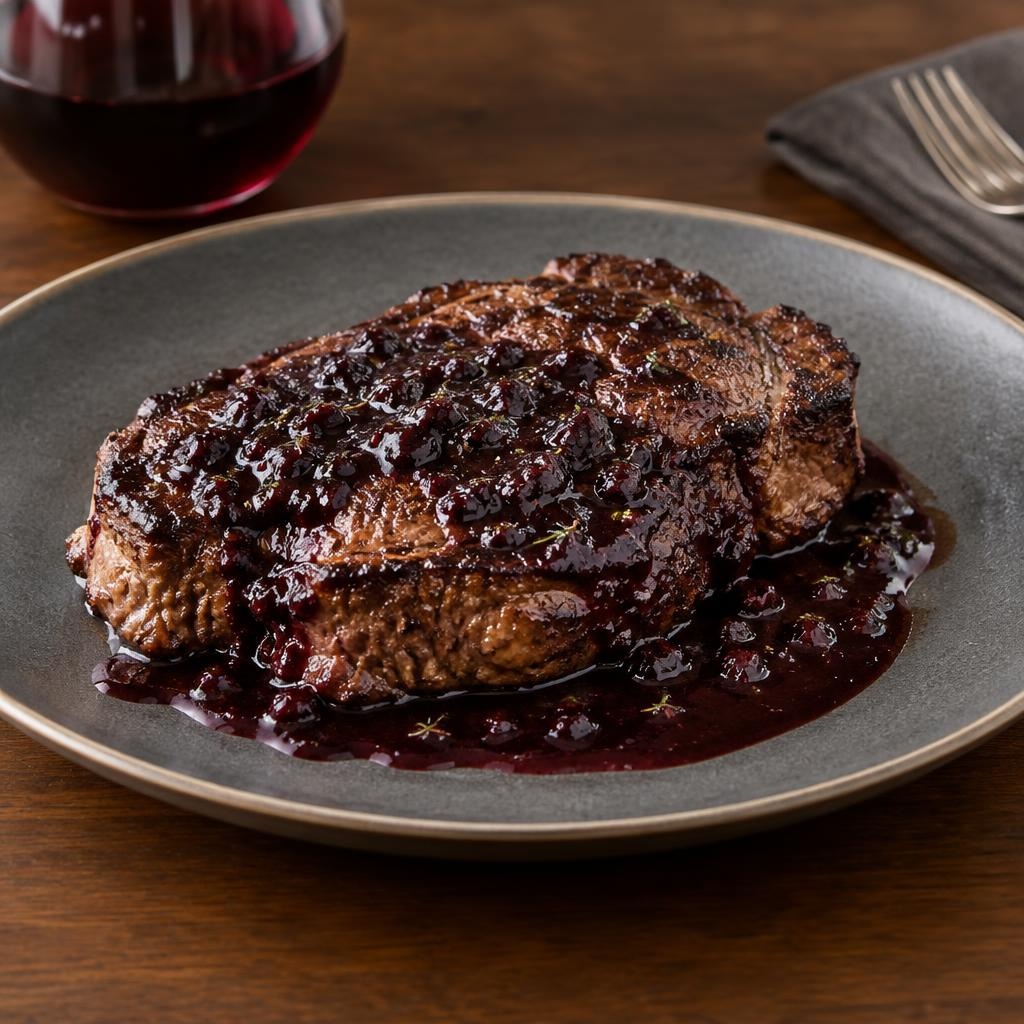
Entree: United States – Oregon – Elk ribeye with marionberry reduction
Food safety reminder: Follow safe food-handling practices and use a food thermometer to verify safe internal cooking temperatures.
Serving Size: 2
Ingredients
- 2 elk ribeye steaks, boneless, raw, usable weight approx. 10 oz (280 g) each
- 2 tbsp (30 ml) olive oil
- 2 tbsp (28 g) unsalted butter, divided
- salt, to taste
- black pepper, to taste
- 1 small shallot, minced, about 1 oz (30 g)
- 1/2 cup (120 ml) dry red wine
- 1/3 cup (80 g) marionberry sauce (prepared marionberry preserve or coulis)
- 1/2 cup (120 ml) beef stock or low-sodium beef broth
- 1 tsp (1 g) fresh thyme leaves, chopped
- 1 tsp (5 ml) balsamic vinegar
- 1 tbsp (15 ml) cold unsalted butter (for mounting sauce)
Instructions
1. Remove steaks from refrigerator 30–45 minutes before cooking to come near room temperature; pat dry and season both sides with salt, to taste and black pepper, to taste.
2. Heat a heavy skillet (cast iron preferred) over medium-high heat until very hot. Add olive oil and 1 tbsp (14 g) butter; when butter foams, add steaks and sear without moving 3–4 minutes per side for medium-rare (internal temperature 125–130°F / 52–54°C), adjusting time for steak thickness. Optionally sear edges briefly. Transfer steaks to a warm plate and tent loosely with foil to rest 8–10 minutes.
3. Reduce heat to medium. Add minced shallot to the same skillet and sauté in the pan fond for 1–2 minutes until softened, stirring to release browned bits.
4. Pour in red wine to deglaze, scraping the pan, and simmer until reduced by about half (2–3 minutes). Add marionberry sauce and beef stock, bring to a simmer and reduce until sauce thickly coats the back of a spoon, about 4–6 minutes.
5. Stir in thyme and balsamic vinegar, then swirl in the remaining 1 tbsp (14 g) cold butter to finish the sauce and add sheen; taste and adjust seasoning with salt, to taste and black pepper, to taste.
6. Slice steaks against the grain, plate, and spoon marionberry reduction over the meat. Serve immediately.
Estimated Nutritional Information*
Per serving | Servings: 2
Calories: 1019 kcal
Carbohydrates: 4.8 g
Protein: 53.5 g
Fat: 83.1 g
Saturated fat: 35.6 g
Trans fat: 3.3 g
Cholesterol: 241 mg
Fiber: 0.6 g
Sugar: 2.1 g
Sodium: 303 mg
Potassium: 800 mg
Calcium: 43 mg
Iron: 5.52 mg
Vitamin A: 160 µg RAE
Vitamin C: 2 mg
Vitamin D: 0.3 µg
Generated: 2026-11-07T00:40:32+00:00
*Values are estimates based on USDA data and mathematical calculations. Actual values may vary. Where data are unavailable, those contributions are excluded. Calories, Carbohydrates, Protein, Fat, Saturated fat, Sodium, Potassium, Calcium, Iron, Vitamin A and Vitamin C are known subtotals. Trans fat is a known subtotal, with data for 5 of 9 ingredients. Cholesterol, Fiber, Sugar and Vitamin D are known subtotals, with data for 8 of 9 ingredients. Missing contributions are unknown, not zero.