Entree: United States – Roast Chicken
Food safety reminder: Follow safe food-handling practices and use a food thermometer to verify safe internal cooking temperatures.
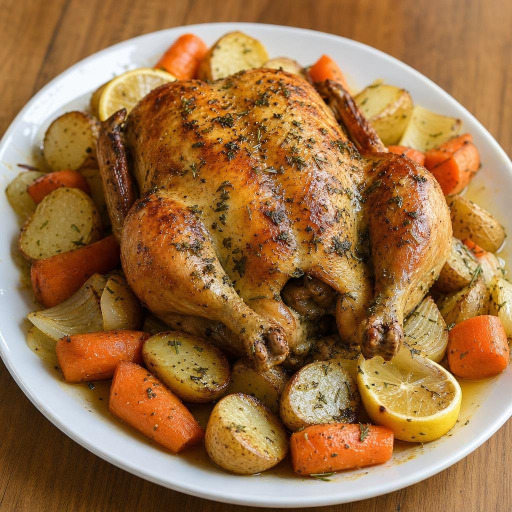
Serving Size: 4
Approximate Time
Prep
20 min
Cook
1 hr 15 min
Additional
15 min
Total
1 hr 50 min
Ingredients
- 1 whole chicken, approx. 4 lb (1.8 kg) total
- 4 tbsp (60 g) unsalted butter, softened
- 2 tbsp (30 ml) olive oil
- 2 tsp (12 g) kosher salt
- 1 tsp (2 g) freshly ground black pepper
- 2 tbsp (8 g) fresh chopped thyme
- 1 tbsp (4 g) fresh chopped rosemary
- 4 cloves garlic, minced
- 1 lemon, halved
- 1 large onion, quartered
- 4 medium carrots, peeled and cut into 2-inch (5 cm) pieces
- 1 lb (454 g) baby potatoes, halved
- 1/2 cup (120 ml) low-sodium chicken stock
Instructions
1. Preheat oven to 425°F (220°C). Pat the chicken dry inside and out with paper towels.
2. In a small bowl, mix butter, 1 tbsp (4 g) thyme, 1/2 tbsp (2 g) rosemary, minced garlic, 1 tsp (6 g) salt and 1/2 tsp (1 g) pepper. Gently loosen the skin over the breasts and spread half the herb butter under the skin; rub the remaining butter over the skin.
3. Season the cavity with remaining salt and pepper; place lemon halves and quartered onion inside. Tie legs together with kitchen twine and tuck wings under.
4. Toss carrots and potatoes with olive oil, remaining thyme and rosemary, and a pinch of salt and pepper; arrange in a roasting pan and set the chicken on top, breast-side up.
5. Roast at 425°F (220°C) for 15 minutes to begin browning, then reduce heat to 375°F (190°C) and continue roasting until an instant-read thermometer inserted into the thickest part of the thigh reads 165°F (74°C), about 45–60 more minutes for a 4 lb (1.8 kg) bird (total time ~1 hr 15 min); baste pan juices over the chicken once or twice.
6. Remove chicken to a cutting board and tent loosely with foil; pour pan juices into a small saucepan, add chicken stock, simmer 2–3 minutes and skim fat to make a simple jus. Rest chicken 10–15 minutes before carving and serve with roasted vegetables and jus.
Estimated Nutritional Information*
Per serving | Servings: 4
Calories: 896 kcal
Carbohydrates: 32.1 g
Protein: 55.2 g
Fat: 60.5 g
Saturated fat: 20.4 g
Cholesterol: 238 mg
Fiber: 5.4 g
Sugar: 5.9 g
Sodium: 1477 mg
Potassium: 1320 mg
Calcium: 91 mg
Iron: 3.97 mg
Vitamin A: 725 µg RAE
Vitamin C: 42.8 mg
Vitamin D: 0.5 µg
Generated: 2026-11-05T20:04:37+00:00
*Values are estimates based on USDA data and mathematical calculations. Actual values may vary. Where data are unavailable, those contributions are excluded. Calories, Carbohydrates, Protein, Fat, Saturated fat, Cholesterol, Fiber, Sugar, Sodium, Potassium, Calcium, Iron, Vitamin A, Vitamin C and Vitamin D are known subtotals. Missing contributions are unknown, not zero.