Entree: Argentina – Pampas – Argentine Asado de Tira (Grilled Cross-Cut Short Ribs)
Food safety reminder: Follow safe food-handling practices and use a food thermometer to verify safe internal cooking temperatures.
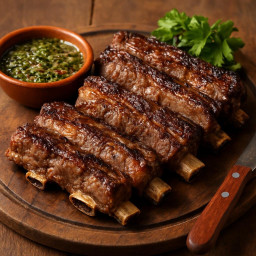
Serving Size: 4
Approximate Time
Prep
10 min
Cook
20 min
Additional
30 min
Total
1 hr
Ingredients
U.S. measurements first, metric equivalents in parentheses. Conversions are approximate; oz means weight ounces, not fluid ounces.
- 6 tira de asado (cross-cut short ribs), approx. 8 oz (225 g) each
- Coarse sea salt or sal gruesa, to taste
- 1 cup (240 ml) chimichurri (see ingredients below) or store-bought
Chimichurri (optional, to make 1 cup (240 ml)):
- 1 cup (25 g) flat-leaf parsley, finely chopped
- 4 cloves garlic, minced
- 2 tbsp (30 ml) fresh oregano, chopped (or 1 tsp (5 ml) dried)
- 1/3 cup (80 ml) red wine vinegar
- 1/2 cup (120 ml) olive oil
- 1/2 tsp (2.5 ml) red pepper flakes
- Salt to taste
Show original ingredient measurements
- 6 tira de asado (cross-cut short ribs), approx. 8 oz (225 g) each
- Coarse sea salt or sal gruesa, to taste
- 1 cup (240 ml) chimichurri (see ingredients below) or store-bought
Chimichurri (optional, to make 1 cup):
- 1 cup (25 g) flat-leaf parsley, finely chopped
- 4 cloves garlic, minced
- 2 tbsp (30 ml) fresh oregano, chopped (or 1 tsp dried)
- 1/3 cup (80 ml) red wine vinegar
- 1/2 cup (120 ml) olive oil
- 1/2 tsp (2.5 ml) red pepper flakes
- Salt to taste
Instructions
1. Bring ribs to near room temperature and season the meat liberally with coarse sea salt on both sides shortly before grilling (Argentine tradition favors salting just before or during cooking). Prepare chimichurri by combining parsley, garlic, oregano, red wine vinegar, olive oil, red pepper flakes, and salt; let sit at least 30 minutes.
2. Build a medium-high coal fire (or preheat grill) and cook ribs over direct heat 6–10 minutes per side depending on thickness, turning once, until exterior is browned and interior reaches desired doneness; avoid excessive flipping. Remove to a cutting board, rest 5–10 minutes, and serve with chimichurri on the side for spooning over the meat.
Estimated Nutritional Information*
Per serving | Servings: 4
Calories: 988 kcal
Carbohydrates: 1.7 g
Protein: 55.3 g
Fat: 84.6 g
Saturated fat: 28.8 g
Fiber: 0.4 g
Sugar: 0.1 g
Sodium: 251 mg
Potassium: 932 mg
Calcium: 58 mg
Iron: 7.82 mg
Vitamin A: 44 µg RAE
Vitamin C: 9.5 mg
Generated: 2026-11-06T05:44:35+00:00
*Values are estimates based on USDA data and mathematical calculations. Actual values may vary. Where data are unavailable, those contributions are excluded. Calories, Carbohydrates, Protein, Fat, Saturated fat, Fiber, Sugar, Sodium, Potassium, Calcium, Iron, Vitamin A and Vitamin C are known subtotals. Missing contributions are unknown, not zero.