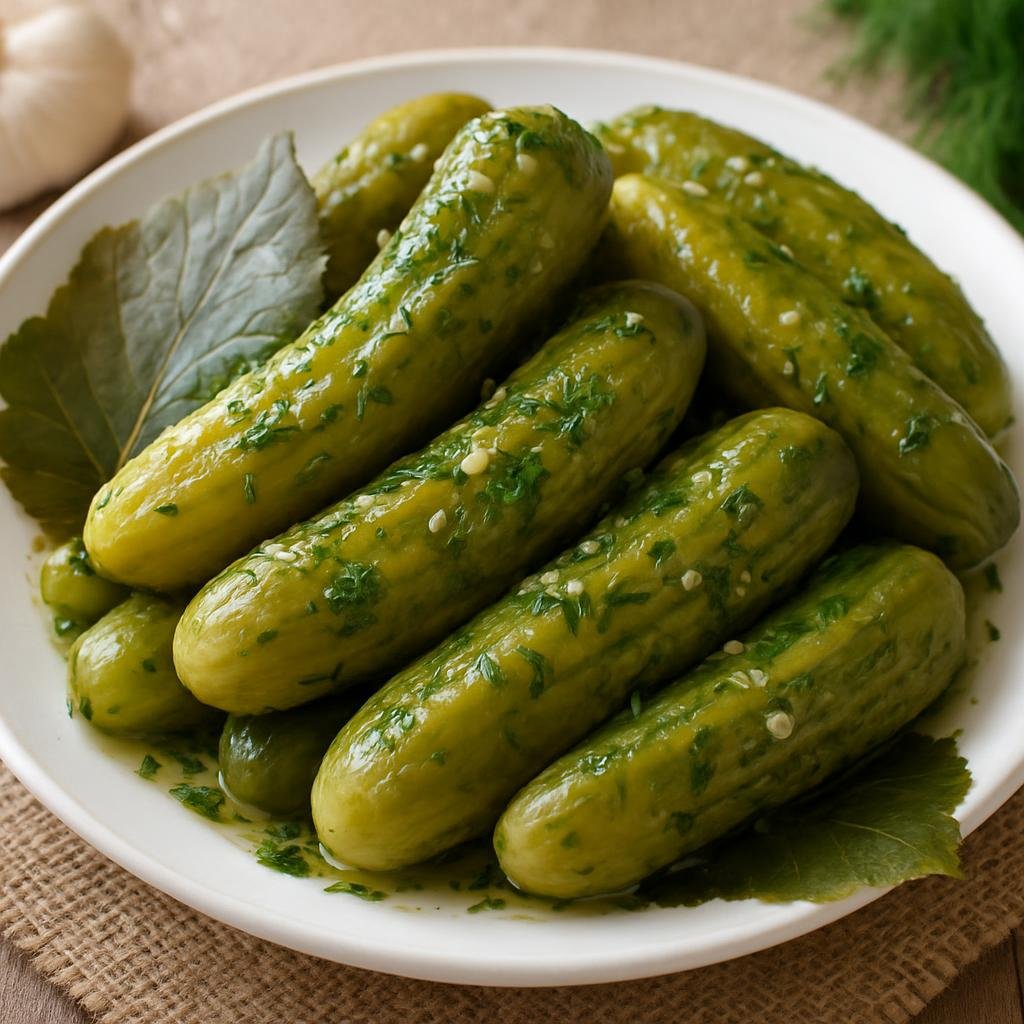
Appetizer: United States – Mid-Atlantic United States (New York) – New York Deli Pickles
Food safety reminder: Follow safe food-handling practices and use a food thermometer to verify safe internal cooking temperatures.
Serving Size: 8
Approximate Time
Prep
20 min
Cook
0 min
Additional
12 hrs
Total
12 hrs
Ingredients
U.S. measurements first, metric equivalents in parentheses. Conversions are approximate; oz means weight ounces, not fluid ounces.
- 4 lb (1.8 kg) small pickling cucumbers (Kirby or Persian), scrubbed and trimmed
- 4 cups (946 ml) non-chlorinated water
- 3 tbsp (45 g) pickling salt or canning salt (non-iodized)
- 6–8 fresh dill heads (fronds attached), about 3 oz (85 g) total
- 10–12 garlic cloves, peeled (about 2 oz (60 g))
- 2 tbsp (18 g) yellow mustard seeds
- 1 tbsp (6 g) coriander seeds
- 1 tbsp (6 g) whole black peppercorns
- 2 bay leaves
- 1 tsp (2 g) crushed red pepper flakes (optional, for slight heat)
- 2–3 grape leaves or 1 tbsp (2 g) loose black tea leaves (optional, for crispness)
- 2–3 quart (946 ml) glass jars with lids (or equivalent total jar volume)
Show original ingredient measurements
- 4 lb (1.8 kg) small pickling cucumbers (Kirby or Persian), scrubbed and trimmed
- 4 cups (946 ml) non-chlorinated water
- 3 tbsp (45 g) pickling salt or canning salt (non-iodized)
- 6–8 fresh dill heads (fronds attached), about 3 oz (85 g) total
- 10–12 garlic cloves, peeled (about 2 oz / 60 g)
- 2 tbsp (18 g) yellow mustard seeds
- 1 tbsp (6 g) coriander seeds
- 1 tbsp (6 g) whole black peppercorns
- 2 bay leaves
- 1 tsp (2 g) crushed red pepper flakes (optional, for slight heat)
- 2–3 grape leaves or 1 tbsp (2 g) loose black tea leaves (optional, for crispness)
- 2–3 quart (946 ml) glass jars with lids (or equivalent total jar volume)
Instructions
Short Description:
Classic New York deli-style pickles: whole or speared cucumbers fermented in a garlicky, dill-forward brine until distinctly sour and crisp. They are salty, pungent, and built to stand beside sandwiches and cured meats.

Regional Notes:
This Mid-Atlantic/New York version uses true lacto-fermentation (no vinegar) and a heavy garlic-and-dill profile common to Jewish delis and bodegas in New York City. Grape or oak leaves (or black tea) are often added for tannins to help maintain a crisp bite; the result is a long, clean sourness rather than a quick vinegar tang.

1. Prepare cucumbers: wash and trim a thin slice off blossom ends (the blossom end contains enzymes that soften pickles). Leave cucumbers whole for deli-style pickles or halve/quarter lengthwise for spears.
2. Make brine: stir the pickling salt into the non-chlorinated water until fully dissolved.
3. Pack jars: divide dill heads, garlic cloves, mustard seeds, coriander seeds, peppercorns, bay leaves, and red pepper flakes (if using) evenly among jars. Tuck in a grape leaf or a pinch of black tea into each jar if using.
4. Add cucumbers: pack cucumbers tightly into jars upright so they fit without crushing, leaving about 1/2 inch (12 mm) headspace at the top.
5. Add brine and weigh down: pour the salt brine over the cucumbers, ensuring they are fully submerged and still leaving ~1/2 inch (12 mm) headspace. Use a fermentation weight, a small clean jar, or a folded cabbage leaf to keep cucumbers below the brine.
6. Cover: close lids loosely (to allow gas to escape) or use fermentation lids/airlocks. Place jars on a tray to catch any overflow and set them in a cool, dark place at 65–75°F (18–24°C).
7. Ferment: allow to ferment 3–10 days, checking daily. Press down to keep cucumbers submerged. Begin tasting after day 4; the pickles should develop a bright, sour, garlicky flavor. Fermentation time depends on ambient temperature and your sourness preference.
8. Finish and refrigerate: once pickles reach desired sourness, tighten lids and move jars to the refrigerator to slow fermentation. Chill at least 1 week before serving for best texture and flavor; flavor continues to mellow over several weeks.
9. Serve: offer whole pickles or cut into spears. Keep refrigerated and consume within 2–3 months. Discard any jar with foul odors, unusual colors (pink/black), or fuzzy mold; a thin white kahm yeast can be skimmed, but when in doubt discard.
Estimated Nutritional Information*
Per serving | Servings: 8
Calories: 40 kcal
Carbohydrates: 9.4 g
Protein: 1.8 g
Fat: 0.5 g
Saturated fat: 0.1 g
Fiber: 1.8 g
Sodium: 2215 mg
Potassium: 359 mg
Calcium: 52 mg
Iron: 0.92 mg
Vitamin A: 17 µg RAE
Vitamin C: 6.7 mg
Generated: 2026-11-05T20:00:24+00:00
*Values are estimates based on USDA data and mathematical calculations. Actual values may vary. Where data are unavailable, those contributions are excluded. Calories, Carbohydrates, Protein, Fat, Saturated fat, Fiber, Sodium, Potassium, Calcium, Iron, Vitamin A and Vitamin C are known subtotals. Missing contributions are unknown, not zero.