Entree: India – Haryana & Western Uttar Pradesh – घेवर ➤ ghevar (crisp disc-shaped deep-fried milk batter cake soaked in sugar syrup and garnished with rabri and nuts)
Food safety reminder: Follow safe food-handling practices and use a food thermometer to verify safe internal cooking temperatures.
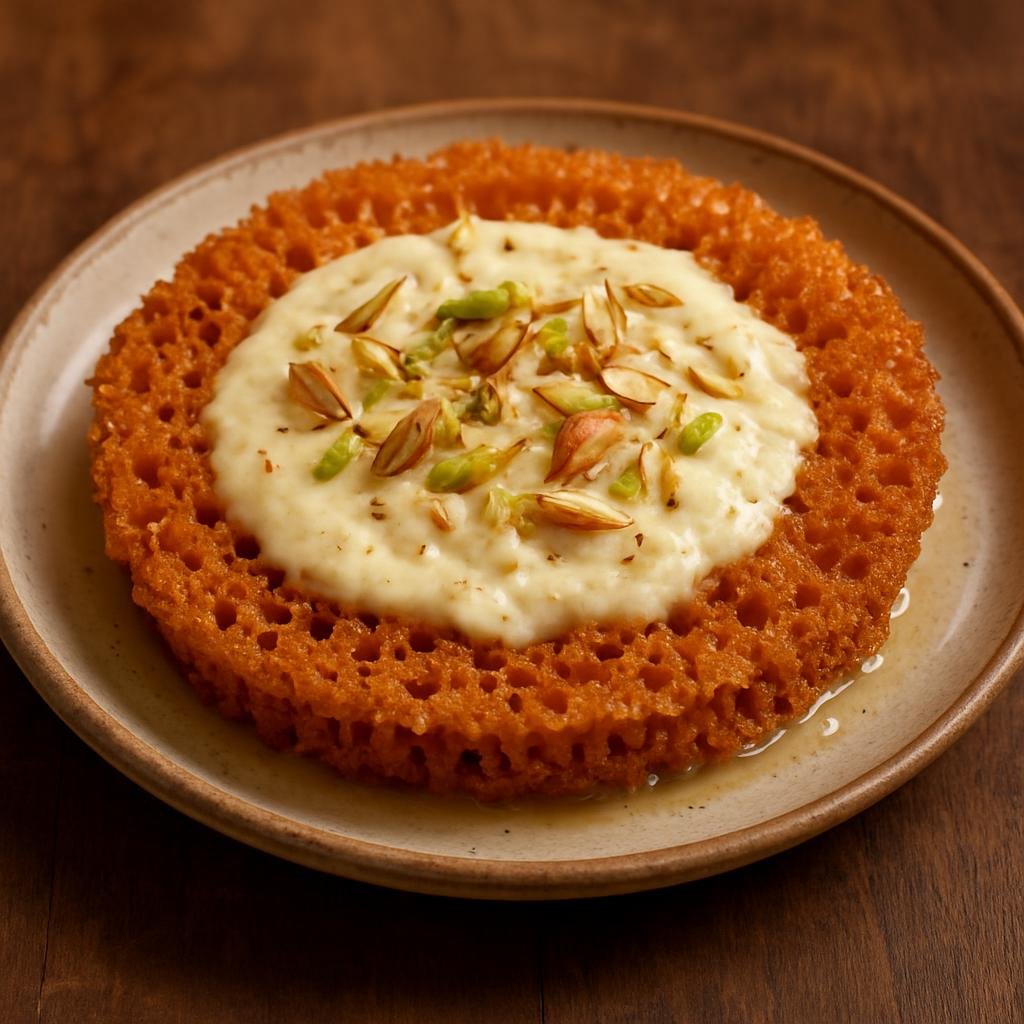
Serving Size: 6
Approximate Time
Prep
45 min
Cook
20 min
Additional
1 hr
Total
1 hr 50 min
Ingredients
- 2 cups (250 g) all-purpose flour (maida)
- 1/4 cup (50 g) fine semolina (rava/sooji)
- 3 tbsp (45 g) ghee, melted
- 1 1/4 cups (300 ml) whole milk, warm, plus more as needed to adjust batter
- 1/2 cup (120 ml) plain yogurt, whisked
- 1 tsp (5 g) baking powder
- 4 cups (960 ml) ghee or neutral oil for deep-frying
- 2 cups (400 g) granulated sugar
- 1 cup (240 ml) water
- 1/2 tsp (1 g) cardamom powder
- A few saffron strands soaked in 1 tbsp (15 ml) warm milk
- 4 cups (960 ml) whole milk for rabri
- 1/4 cup (50 g) sugar for rabri
- 1/2 cup (120 g) khoya or mawa, grated (optional richer topping)
- 1/4 cup (30 g) sliced almonds
- 1/4 cup (30 g) sliced pistachios
- 2 tbsp (30 ml) rose syrup or a few drops of rose water (optional)
Instructions
U.S. measurements first, metric equivalents in parentheses. Conversions are approximate.
1. Make the syrup first: combine 2 cups (480 ml) sugar and 1 cup (240 ml) water in a saucepan, bring to a boil, then simmer until slightly sticky (one-thread consistency), about 8–10 minutes. Stir in cardamom powder and saffron milk, keep warm.
2. Prepare rabri: in a wide heavy-bottomed pan, bring 4 cups (960 ml) milk to a gentle boil, reduce heat and simmer, stirring occasionally, until reduced to about one-third and thickened, about 40–50 minutes. Add 1/4 cup (60 ml) sugar and simmer 5 more minutes. Remove from heat and cool slightly; keep warm.
3. Whisk together flour, semolina, and baking powder in a bowl. Stir in melted ghee, yogurt, and warm milk to make a smooth, lump-free batter of pouring consistency (similar to pancake batter). Add more milk if too thick.
4. Heat ghee or oil in a deep, wide kadhai or heavy-bottomed pan to 350°F (175°C). To test, drop a small amount of batter — it should sizzle and rise immediately.
5. To form a ghevar, hold a small ladle or spoon above the hot oil and pour batter in a thin, steady stream in concentric circles to create a lattice disc. Alternatively, pour a small amount of batter and swirl quickly with the ladle to form a hollow center. Fry until deep golden and crisp on both sides, flipping once, about 4–6 minutes per disc depending on size.
6. Remove fried ghevar on a rack for a few seconds, then immediately dip or pour warm sugar syrup over each hot disc so syrup soaks into pores. Place on a tray to drain briefly.
7. Once slightly cooled but still moist, top each ghevar with a spoonful of warm rabri, sprinkle grated khoya if using, and garnish with sliced almonds and pistachios. Add a few drops of rose syrup or rose water if desired.
8. Serve ghevar at room temperature. Store covered; best consumed within 24 hours for optimal crispness and texture.
Show original instructions
1. Make the syrup first: combine 2 cups sugar and 1 cup water in a saucepan, bring to a boil, then simmer until slightly sticky (one-thread consistency), about 8–10 minutes. Stir in cardamom powder and saffron milk, keep warm.
2. Prepare rabri: in a wide heavy-bottomed pan, bring 4 cups milk to a gentle boil, reduce heat and simmer, stirring occasionally, until reduced to about one-third and thickened, about 40–50 minutes. Add 1/4 cup sugar and simmer 5 more minutes. Remove from heat and cool slightly; keep warm.
3. Whisk together flour, semolina, and baking powder in a bowl. Stir in melted ghee, yogurt, and warm milk to make a smooth, lump-free batter of pouring consistency (similar to pancake batter). Add more milk if too thick.
4. Heat ghee or oil in a deep, wide kadhai or heavy-bottomed pan to 350°F (175°C). To test, drop a small amount of batter — it should sizzle and rise immediately.
5. To form a ghevar, hold a small ladle or spoon above the hot oil and pour batter in a thin, steady stream in concentric circles to create a lattice disc. Alternatively, pour a small amount of batter and swirl quickly with the ladle to form a hollow center. Fry until deep golden and crisp on both sides, flipping once, about 4–6 minutes per disc depending on size.
6. Remove fried ghevar on a rack for a few seconds, then immediately dip or pour warm sugar syrup over each hot disc so syrup soaks into pores. Place on a tray to drain briefly.
7. Once slightly cooled but still moist, top each ghevar with a spoonful of warm rabri, sprinkle grated khoya if using, and garnish with sliced almonds and pistachios. Add a few drops of rose syrup or rose water if desired.
8. Serve ghevar at room temperature. Store covered; best consumed within 24 hours for optimal crispness and texture.
Estimated Nutritional Information*
Per serving | Servings: 6
Calories: 1935 kcal
Carbohydrates: 126.7 g
Protein: 15.3 g
Fat: 156.3 g
Saturated fat: 94.2 g
Cholesterol: 393 mg
Fiber: 2.6 g
Sodium: 196 mg
Potassium: 470 mg
Calcium: 349 mg
Iron: 2.62 mg
Vitamin A: 1316 µg RAE
Vitamin C: 0.4 mg
Vitamin D: 2.8 µg
Generated: 2026-11-05T19:56:02+00:00
*Values are estimates based on USDA data and mathematical calculations. Actual values may vary. Where data are unavailable, those contributions are excluded. Calories, Carbohydrates, Protein, Fat, Saturated fat, Cholesterol, Fiber, Sodium, Potassium, Calcium, Iron, Vitamin A, Vitamin C and Vitamin D are known subtotals. Missing contributions are unknown, not zero.