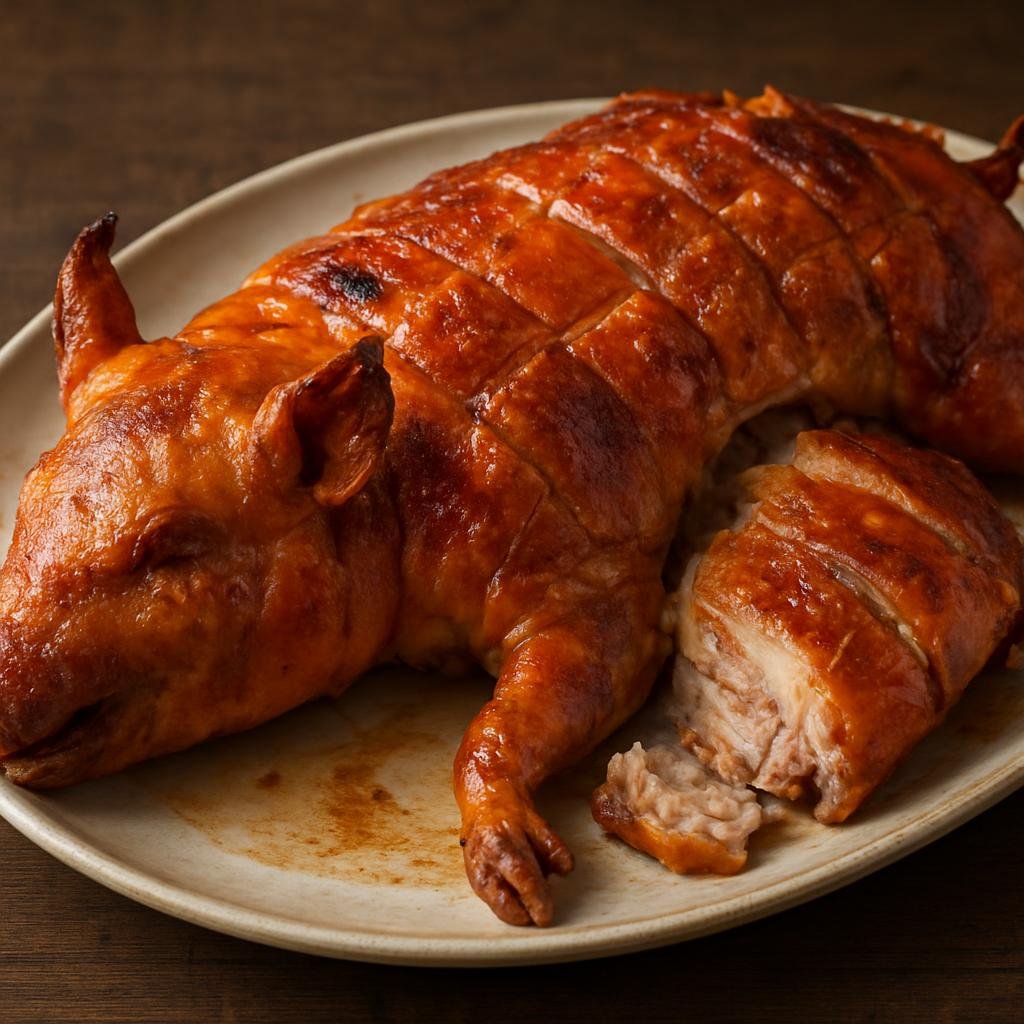
Entree: Spain – Madrid & Castile – Cochinillo Asado (Roast suckling pig with crisp crackling and tender meat, roasted slowly in the traditional Castilian style)
Food safety reminder: Follow safe food-handling practices and use a food thermometer to verify safe internal cooking temperatures.
Ingredients
U.S. measurements first, metric equivalents in parentheses. Conversions are approximate; oz means weight ounces, not fluid ounces.
- 1 whole suckling pig, approx. 8 lb (3.6 kg)
- 2 tbsp (30 g) coarse sea salt
- 4 tbsp (60 ml) lard or olive oil, melted
- 4 cloves garlic, crushed (approx. 0.42 oz (12 g))
- 1 cup (240 ml) water or light chicken broth
- 2 tbsp (30 ml) dry white wine (optional)
- 1 lemon, cut into wedges (for serving)
- Fresh thyme or rosemary sprigs (optional, for aroma)
Show original ingredient measurements
- 1 whole suckling pig, approx. 8 lb (3.6 kg)
- 2 tbsp (30 g) coarse sea salt
- 4 tbsp (60 ml) lard or olive oil, melted
- 4 cloves garlic, crushed (approx. 12 g)
- 1 cup (240 ml) water or light chicken broth
- 2 tbsp (30 ml) dry white wine (optional)
- 1 lemon, cut into wedges (for serving)
- Fresh thyme or rosemary sprigs (optional, for aroma)
Instructions
U.S. measurements first, metric equivalents in parentheses. Conversions are approximate.
1. Preheat the oven to 475°F (245°C). Pat the pig thoroughly dry, especially the skin; scoring the skin lightly with a sharp knife in a shallow crisscross pattern helps render fat and crisp the rind.
2. Rub the entire pig, skin and cavity, with coarse sea salt. Mix the melted lard or olive oil with crushed garlic and brush over the skin and inside the cavity. If using, place a few thyme or rosemary sprigs in the cavity.
3. Place the pig breast-side up on a rack set in a roasting pan. Pour 1 cup (240 ml) water (and 2 tbsp (30 ml) wine if using) into the pan to keep drippings from burning and to add moisture. Tuck limbs if needed and truss lightly so the pig cooks evenly.
4. Roast for 20–30 minutes at 475°F (245°C) to jump-start browning and blister the skin, then reduce oven temperature to 325°F (160°C). Continue roasting uncovered for 2 to 2 1/2 hours, basting occasionally with pan juices, until the skin is deep golden and crackling and the meat is very tender. If skin browns too quickly, cover loosely with foil.
5. Check doneness by ensuring juices run clear from the thickest part and the meat pulls easily from the bone; for safety, the thickest part should register at least 160°F (71°C) on an instant-read thermometer. Remove from oven and let rest 20 minutes.
6. Carve at the table or transfer to a platter; serve with lemon wedges and pan juices spooned over slices. Traditional presentation often includes cutting the crackling first and serving generous portions of tender meat.
Show original instructions
1. Preheat the oven to 475°F (245°C). Pat the pig thoroughly dry, especially the skin; scoring the skin lightly with a sharp knife in a shallow crisscross pattern helps render fat and crisp the rind.
2. Rub the entire pig, skin and cavity, with coarse sea salt. Mix the melted lard or olive oil with crushed garlic and brush over the skin and inside the cavity. If using, place a few thyme or rosemary sprigs in the cavity.
3. Place the pig breast-side up on a rack set in a roasting pan. Pour 1 cup water (and 2 tbsp wine if using) into the pan to keep drippings from burning and to add moisture. Tuck limbs if needed and truss lightly so the pig cooks evenly.
4. Roast for 20–30 minutes at 475°F (245°C) to jump-start browning and blister the skin, then reduce oven temperature to 325°F (160°C). Continue roasting uncovered for 2 to 2 1/2 hours, basting occasionally with pan juices, until the skin is deep golden and crackling and the meat is very tender. If skin browns too quickly, cover loosely with foil.
5. Check doneness by ensuring juices run clear from the thickest part and the meat pulls easily from the bone; for safety, the thickest part should register at least 160°F (71°C) on an instant-read thermometer. Remove from oven and let rest 20 minutes.
6. Carve at the table or transfer to a platter; serve with lemon wedges and pan juices spooned over slices. Traditional presentation often includes cutting the crackling first and serving generous portions of tender meat.
Per serving | Servings: 6
Nutrition estimated: November 5, 2026
*Values are estimates based on USDA data and mathematical calculations. Actual values may vary. Where data are unavailable, those contributions are excluded. Calories, Carbohydrates, Protein, Fat, Saturated fat, Cholesterol, Fiber, Sugar, Sodium, Potassium, Calcium, Iron, Vitamin A, Vitamin C and Vitamin D are known subtotals. Missing contributions are unknown, not zero.