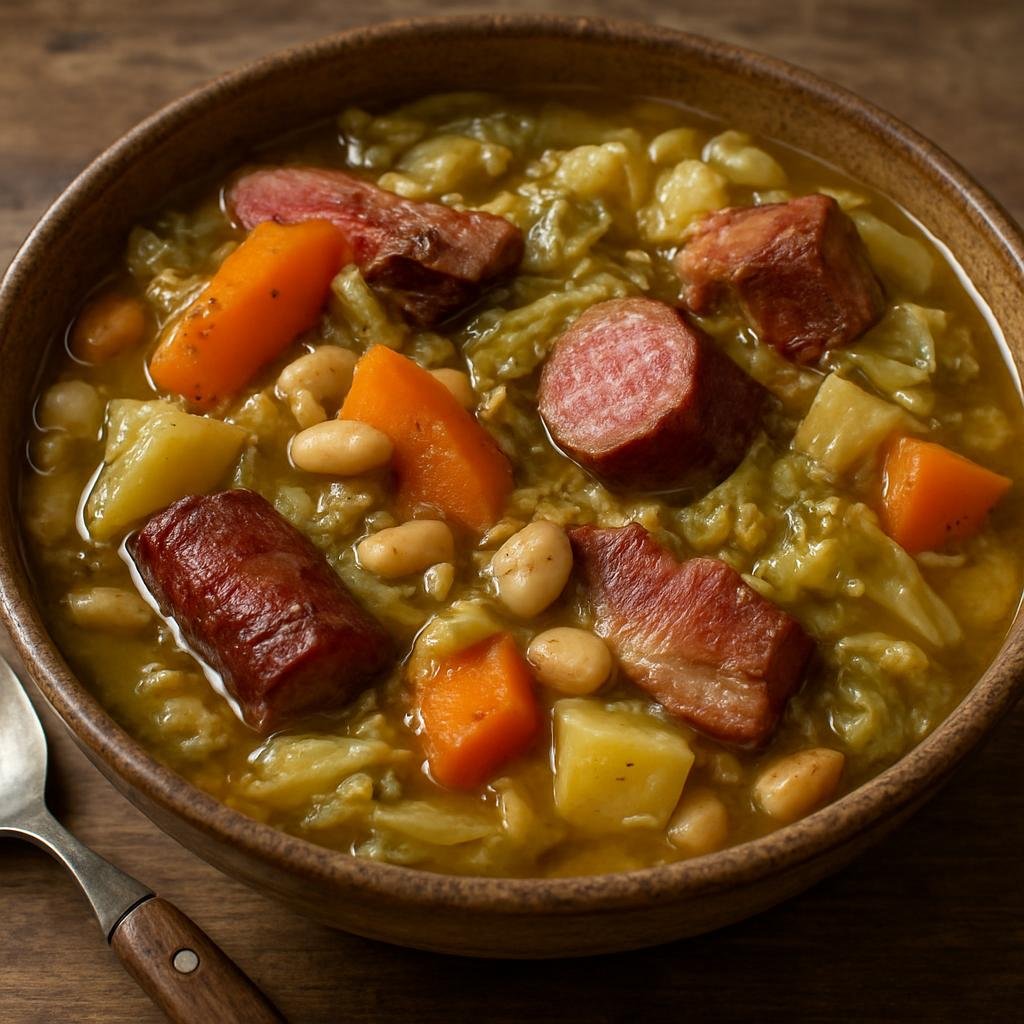
Entree: France – Gascony – Garbure (Hearty Gascony country stew of cabbage, beans, root vegetables and preserved meats)
Food safety reminder: Follow safe food-handling practices and use a food thermometer to verify safe internal cooking temperatures.
Serving Size: 6
Approximate Time
Prep
30 min
Cook
2 hrs
Total
2 hrs 30 min
Ingredients
U.S. measurements first, metric equivalents in parentheses. Conversions are approximate; oz means weight ounces, not fluid ounces.
1 lb (450 g) dried white beans (Tarbais or cannellini), soaked overnight and drained
1 smoked ham hock, approx. 1 lb (450 g)
2 confit duck legs, approx. 6 oz (170 g) each (12 oz (340 g) gross; estimated 7 1/4 oz (205 g) cooked edible meat and skin after bone; use cooked duck leg meat and skin as the catalog proxy for confit)
6 cups (1.4 L) chicken stock
2 tbsp (30 ml) duck fat or olive oil
1 medium head green cabbage, cored and roughly chopped
3 medium carrots, about 8 oz (225 g), peeled and sliced
2 leeks (white and pale green parts only), about 8 oz (225 g), cleaned and sliced
2 medium potatoes, about 10 oz (280 g), peeled and diced
1 medium onion, about 6 oz (170 g), finely chopped
3 cloves garlic, minced
1 bay leaf
1 sprig fresh thyme or 1/2 tsp (1 g) dried thyme
2 tbsp (30 ml) red wine vinegar, to finish
Salt and freshly ground black pepper to taste
Fresh parsley, chopped, for garnish
Show original ingredient measurements
1 lb (450 g) dried white beans (Tarbais or cannellini), soaked overnight and drained
1 smoked ham hock, approx. 1 lb (450 g)
2 confit duck legs, approx. 6 oz (170 g) each (340 g gross; estimated 205 g cooked edible meat and skin after bone; use cooked duck leg meat and skin as the catalog proxy for confit)
6 cups (1.4 L) chicken stock
2 tbsp (30 ml) duck fat or olive oil
1 medium head green cabbage, cored and roughly chopped
3 medium carrots, about 8 oz (225 g), peeled and sliced
2 leeks (white and pale green parts only), about 8 oz (225 g), cleaned and sliced
2 medium potatoes, about 10 oz (280 g), peeled and diced
1 medium onion, about 6 oz (170 g), finely chopped
3 cloves garlic, minced
1 bay leaf
1 sprig fresh thyme or 1/2 tsp (1 g) dried thyme
2 tbsp (30 ml) red wine vinegar, to finish
Salt and freshly ground black pepper to taste
Fresh parsley, chopped, for garnish
Instructions
U.S. measurements first, metric equivalents in parentheses. Conversions are approximate.
1. Drain the soaked beans and place them in a large heavy pot with the smoked ham hock and enough cold water to cover by 1 inch (2.54 cm); bring to a gentle simmer and blanch for 10 minutes; drain and discard the blanching water, then return beans and ham hock to the pot.
2. Add the chicken stock, bring to a simmer, and skim any foam; reduce heat to low, cover partially, and simmer for 45 minutes.
3. Meanwhile, heat the duck fat or olive oil in a skillet over medium heat; add chopped onion and cook until soft and translucent, about 5 minutes; add minced garlic and cook 1 minute more.
4. Add leeks, carrots and potatoes to the bean pot along with the softened onion mixture, bay leaf, and thyme; stir, cover partially, and continue to simmer gently for 30 minutes.
5. Add the chopped cabbage and the confit duck legs (nestle them in the stew); simmer uncovered for another 20–30 minutes until beans and vegetables are tender and the stew is thick; if too thick, add a little hot water or stock to reach desired consistency.
6. Remove the ham hock; shred any meat and return it to the pot, discarding bone and excess fat; taste and adjust seasoning with salt and pepper.
7. Stir in the red wine vinegar to brighten the flavors; serve hot, garnished with chopped parsley and with crusty country bread.
Show original instructions
1. Drain the soaked beans and place them in a large heavy pot with the smoked ham hock and enough cold water to cover by 1 inch; bring to a gentle simmer and blanch for 10 minutes; drain and discard the blanching water, then return beans and ham hock to the pot.
2. Add the chicken stock, bring to a simmer, and skim any foam; reduce heat to low, cover partially, and simmer for 45 minutes.
3. Meanwhile, heat the duck fat or olive oil in a skillet over medium heat; add chopped onion and cook until soft and translucent, about 5 minutes; add minced garlic and cook 1 minute more.
4. Add leeks, carrots and potatoes to the bean pot along with the softened onion mixture, bay leaf, and thyme; stir, cover partially, and continue to simmer gently for 30 minutes.
5. Add the chopped cabbage and the confit duck legs (nestle them in the stew); simmer uncovered for another 20–30 minutes until beans and vegetables are tender and the stew is thick; if too thick, add a little hot water or stock to reach desired consistency.
6. Remove the ham hock; shred any meat and return it to the pot, discarding bone and excess fat; taste and adjust seasoning with salt and pepper.
7. Stir in the red wine vinegar to brighten the flavors; serve hot, garnished with chopped parsley and with crusty country bread.
Estimated Nutritional Information*
Per serving | Servings: 6
Calories: 614 kcal
Carbohydrates: 75.9 g
Protein: 38.4 g
Fat: 19.2 g
Sodium: 1450 mg
Calcium: 308 mg
Iron: 10.96 mg
Vitamin C: 70.6 mg
Nutrition estimated: November 6, 2026
*Values are estimates based on USDA data and mathematical calculations. Actual values may vary. Where data are unavailable, those contributions are excluded. Calories, Carbohydrates, Protein, Fat, Sodium, Calcium, Iron and Vitamin C are known subtotals. Missing contributions are unknown, not zero.