Entree: Australia – Tasmania – Grilled Atlantic Salmon (Simply seasoned Atlantic salmon fillets grilled and finished with lemon and herbs)
Food safety reminder: Follow safe food-handling practices and use a food thermometer to verify safe internal cooking temperatures.
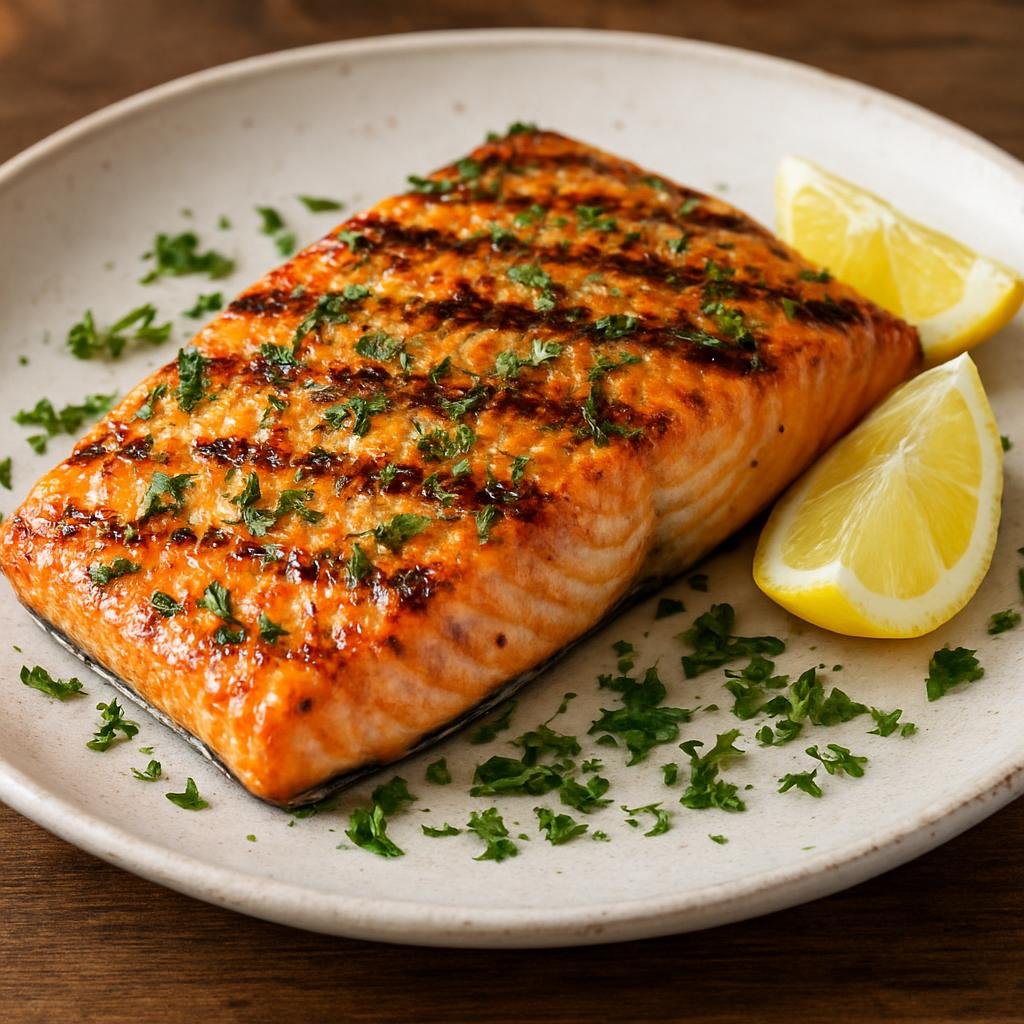
Serving Size: 4
Approximate Time
Prep
10 min
Cook
10 min
Total
20 min
Ingredients
U.S. measurements first, metric equivalents in parentheses. Conversions are approximate; oz means weight ounces, not fluid ounces.
- 4 salmon fillets, approx. 6 oz (170 g) each
- 2 tbsp (30 ml) olive oil
- 1 tsp (5 g) fine sea salt
- 1/2 tsp (1 g) freshly ground black pepper
- 2 cloves garlic, minced, approx. 0.21 oz (6 g)
- 1 tbsp (15 ml) fresh lemon juice
- 1 tbsp (15 ml) chopped fresh parsley
- 2 tbsp (28 g) unsalted butter, optional for finishing
- Lemon wedges for serving
Show original ingredient measurements
- 4 salmon fillets, approx. 6 oz (170 g) each
- 2 tbsp (30 ml) olive oil
- 1 tsp (5 g) fine sea salt
- 1/2 tsp (1 g) freshly ground black pepper
- 2 cloves garlic, minced, approx. 6 g
- 1 tbsp (15 ml) fresh lemon juice
- 1 tbsp (15 ml) chopped fresh parsley
- 2 tbsp (28 g) unsalted butter, optional for finishing
- Lemon wedges for serving
Instructions
1. Pat salmon fillets dry and brush both sides lightly with olive oil. Season evenly with sea salt and black pepper.
2. Preheat a grill or heavy grill pan over medium-high heat until hot and lightly oiled to prevent sticking.
3. Place salmon fillets skin-side down and grill without moving until the skin is crisp and the fish has cooked about two-thirds of the way through, about 4–6 minutes depending on thickness.
4. Flip the fillets carefully and grill the flesh side for 1–3 minutes more until just cooked through and opaque; total internal temperature should reach about 125–130°F (52–54°C) for medium.
5. Meanwhile, mix minced garlic with lemon juice and chopped parsley. When the salmon is off the grill, spoon the lemon-herb mixture over the fillets and add a small pat of butter to melt for a glossy finish.
6. Serve immediately with lemon wedges and a simple green vegetable or roasted potatoes typical of Tasmanian coastal meals.
Estimated Nutritional Information*
Per serving | Servings: 4
Calories: 468 kcal
Carbohydrates: 1 g
Protein: 34.9 g
Fat: 35.3 g
Saturated fat: 9.7 g
Cholesterol: 109 mg
Fiber: 0.1 g
Sugar: 0.1 g
Sodium: 587 mg
Potassium: 637 mg
Calcium: 23 mg
Iron: 0.73 mg
Vitamin A: 151 µg RAE
Vitamin C: 9.8 mg
Vitamin D: 18.7 µg
Nutrition estimated: November 5, 2026
*Values are estimates based on USDA data and mathematical calculations. Actual values may vary. Where data are unavailable, those contributions are excluded. Calories, Carbohydrates, Protein, Fat, Saturated fat, Cholesterol, Fiber, Sugar, Sodium, Potassium, Calcium, Iron, Vitamin A, Vitamin C and Vitamin D are known subtotals. Missing contributions are unknown, not zero.